

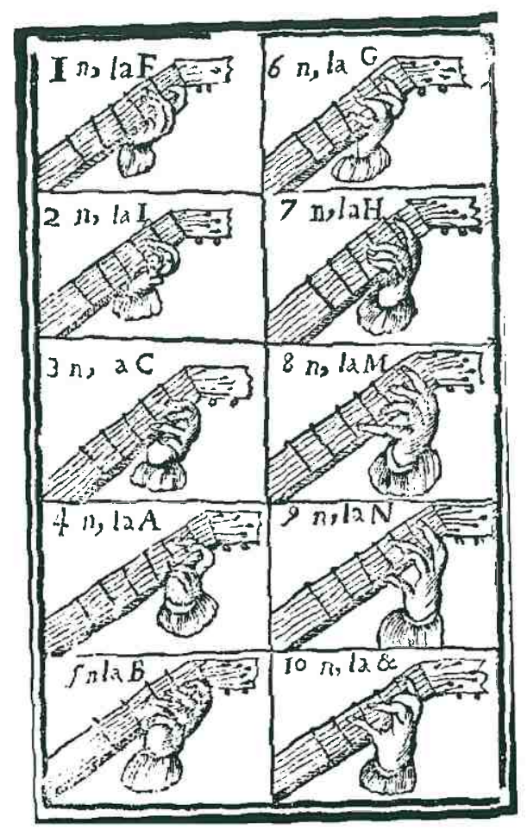
From the ancient cithara, to the six-course Renaissance lute that seems to have often been tuned E-A-D-F#-B-E, to the vihuela tuned similarly, to the five-course guitarra settling on A-D-G-B-E, the standard tuning has a long history that evolved and was handed down through many centuries. An important early and traceable fixture is the 1596 book “Guitarra española y vandola” by Juan Carlos Amat. Written for a five-string guitar-like instrument tuned A-D-G-B-E, it featured drawn chord pictorials not unlike the chord diagrams we still use today.
The six-string guitar evolved quickly after that, adding the sixth string tuned to E.
A note on the CAGED system
Because the standard tuning is an irregular tuning, pattern regularity across the fretboard is broken, unlike with regular tunings such as the all-fourths tuning. A foremost solution to this is to familiarise oneself with the CAGED system.